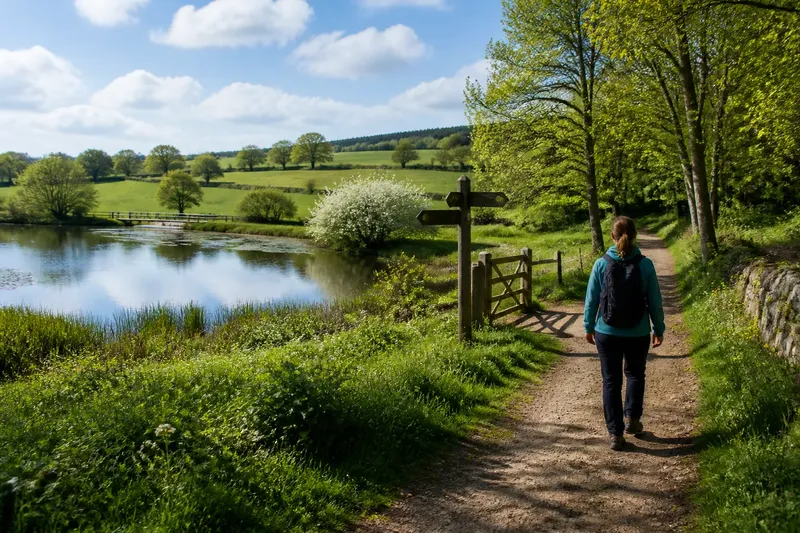
Pocket Notebook or Phone Camera for a Noticing Walk?
Choose a pocket notebook or phone camera for a noticing walk by what you want to remember, with simple prompts for recording details without buying kit.
A pocket notebook or phone camera changes what you notice on a walk: one makes it easy to save words and questions, the other preserves visible detail. Choose by the memory you want to bring home, not by which tool seems more serious. A useful record might be a sentence, a close-up, or a clue to look for next time; it need not be a complete account of the walk.
What do you want to remember?
Before setting out, name one thing you would like to carry back in memory. It could be the shape of a leaf, the sound of a stream under a footbridge, the route of a cloud, or the small change in a familiar tree. That intention helps you choose a recording method without turning the walk into a search for subjects.
A notebook works particularly well for things a camera cannot store directly. Write down a birdsong’s rhythm in your own words, the smell of damp bark, or the thought that came to you while waiting for a bus. A few words are enough to act as a prompt later. They do not have to be polished or botanically precise.
A phone camera is useful when the shape, colour or arrangement matters more than your description. A photograph can preserve how moss follows a crack in a wall or how a seed head catches the light. It can also let you compare a detail with the same place on a later visit, provided you can find the image again.
Think of the choice like taking a small container on a picnic: the best one depends on what you intend to bring back. If you want a record of a feeling or an unanswered question, reach for words. If you want to remember a visible pattern, reach for the camera.
When does a notebook earn its place?
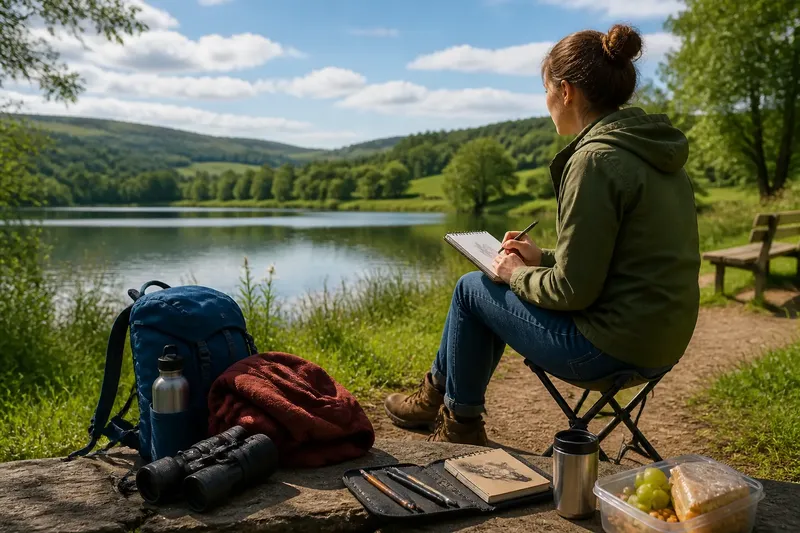
Paper is forgiving. You can jot a phrase while standing still, make a rough arrow between two landmarks, or draw the outline of a leaf without needing the sketch to look accurate. A pocket-sized pad and an ordinary pencil are enough; there is no need for special paper or a dedicated field journal.
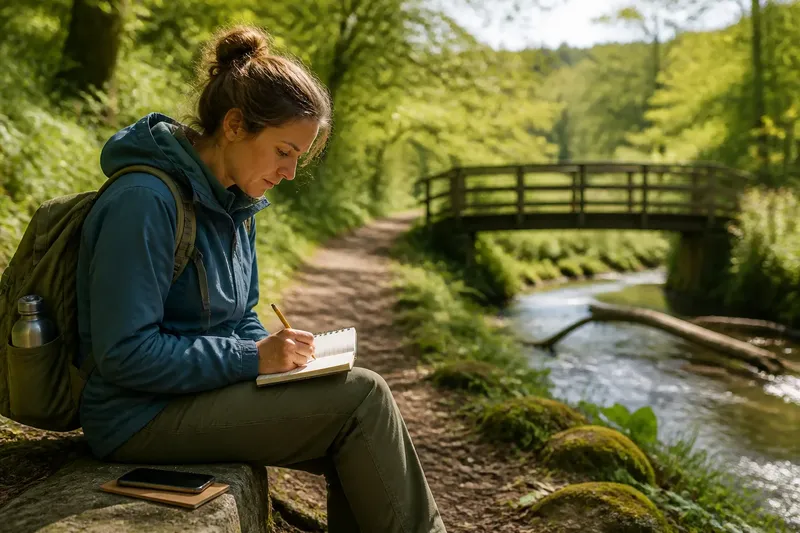
Keep entries brief enough that writing does not take over. Try a three-part note: where, what, and what you wonder. For instance: “By the footbridge; water circles a fallen twig; does it move differently after rain?” The place helps you retrieve the scene, the detail gives it shape, and the question gives a future walk a thread to follow.
Writing can also preserve comparisons that a single image might leave unclear. Note whether the path feels more open after leaves fall, whether a familiar bench catches evening shade, or which direction the wind reaches the sheltered side of a hedge. These are observations, not claims that need to be settled on the spot.
Use a pencil if drizzle or damp hands are likely, and keep the notebook somewhere you can reach without emptying your bag. If you do not want to write while walking, stop at a bench or a safe place away from the path. A few deliberate notes can be more useful than a page of hurried fragments.
When does a phone camera help you see?
Photography rewards looking closely before pressing the shutter. A broad view can show where a feature sits, while a close frame can reveal its texture. Take a moment to choose which of those you want. A useful pair might be a whole branch and one curled leaf, rather than several nearly identical pictures.
Move your feet before zooming. A small shift to one side may separate a flower from a distracting background or show how a shadow falls across a stone. Keep your footing and the path clear; there is no need to lean over a bank or step into vegetation for a better angle.
A phone can also record visual clues that are awkward to describe: the pattern on a discarded feather, the shape of a cloud edge, or the way lichens gather along a fence. Photograph only what is appropriate to photograph. Leave wildlife undisturbed, respect signs and private property, and avoid including identifiable people unless they have agreed.
Images are easy to collect and easy to forget among other images. If you take one, add a short caption or a voice note with the place and what caught your eye. Check that the phone has enough charge for your ordinary needs on the outing, and do not depend on a camera as your only record if the phone is already unreliable.
How can you keep recording from interrupting the walk?
Give yourself a simple rhythm: walk, pause, record, then put the tool away. Let the pause come from something you have actually noticed, rather than stopping at every possible subject. This keeps attention on the surroundings and makes each note or picture carry a reason.
Try a limit that fits your own pace. You might make one notebook entry at a turning point, or take one photograph of a detail that would otherwise be hard to describe. The point is not to ration curiosity; it is to leave room for ordinary looking, listening and moving.
Imagine you reach a muddy stretch and notice tiny tracks crossing the edge of the path. If you want to remember their direction and the nearby landmarks, write a short note and a rough arrow in your notebook. If the visible arrangement is what interests you, take a picture from the path, then add a caption such as “tracks beside the flat stone”. Either choice gives you a prompt without requiring you to disturb the mud or linger in the way of other walkers.
When a subject invites a longer look, put the tool away for a moment. Watch how the branches move, listen for what changes when a passing vehicle fades, or notice whether the light shifts across the ground. The record should support attention, not replace it.
Which tool suits the memory you want to keep?
Choose a notebook if you mainly want to save thoughts, sounds, sequences, questions or details that are hard to frame. Choose a phone camera if a visual shape or arrangement is central to what you want to remember. Carry both only if each has a clear job; otherwise, one familiar tool is often enough.
Here are four questions to settle the choice before you leave:
What will be hardest to recall later?
If it is a phrase, sound or passing thought, write it down. If it is a pattern or precise visual arrangement, a photograph may serve better.
Will you want to compare this place on another visit?
A photograph can make visual comparison easier when you can return to roughly the same viewpoint. A notebook can record changes that matter more as words, such as a path being quieter or a familiar spot feeling more exposed.
Can you use the tool without losing your sense of the walk?
If handling a phone pulls you into notifications or photo sorting, leave it put away and use paper. If stopping to write feels awkward, capture one image and add a brief note only when convenient.
What would you actually look at again?
Choose the format you are likely to revisit: a few clear notebook entries or a small, captioned group of photographs. A record that is easy to find and understand is more useful than one that simply accumulates.
How can you make the record easy to revisit?
Give notebook entries a simple location cue, such as a path name, a bridge, or “under the rowan by the gate”. If you do not know the plant or bird, describe what you can see rather than guessing: “yellow flowers, low beside the gravel” is more honest and more helpful than an uncertain name.
For phone images, use a caption or a short voice note to preserve context. A photograph of a tree might look much like several others later; “split trunk beside the north gate” gives it a place. If you keep images in albums, a small album named for a local route or season can make them easier to find without building an elaborate filing system.
On a later day, revisit one note or image before going out. Look for the feature again, or follow the question you left yourself. If the place has changed, record that change in the same simple way. The point is not to create a complete archive, but to give your attention a useful starting point.
Can you combine words and pictures without carrying more?
Yes. A phone can hold a short text note beside a picture, and a notebook can include a tiny sketch next to a sentence. You do not need to duplicate every observation. Pair the formats only when one adds context the other misses.
For example, a photograph can show the arrangement of branches while a note records that the wind was pushing them towards the path. Or a notebook can hold a rough map while a picture preserves the colour of a small detail. Keep the pairing selective: one clear caption can do more than a long account of everything around the subject.
There is also no need to record every outing. Some walks are better left as a remembered sequence of sensations, with no device or page between you and the place. If you do make a record, choose the tool that fits what you hope to recall, and keep the entry small enough that the walk remains the main event.
For a noticing walk, a pocket notebook or phone camera is simply a way to carry one detail forward. Try one method on your next familiar route: write down a sound you would otherwise lose, or photograph a pattern you want to recognise again. If the record brings that moment back when you look at it later, it has done its job.